
THE BEIJING PROTOCOL: HOW GEN. C.G. MUSA IS RE-ENGINEERING NIGERIA'S DEFENCE FUTURE Cover Story: In a bold strategic move to end decades of foreig
THE BEIJING PROTOCOL: HOW GEN. C.G. MUSA IS RE-ENGINEERING NIGERIA’S DEFENCE FUTURE
Cover Story: In a bold strategic move to end decades of foreign dependency, the Honourable Minister of Defence, General Christopher Gwabin Musa (Rtd), storms China to secure technology—not just weapons.
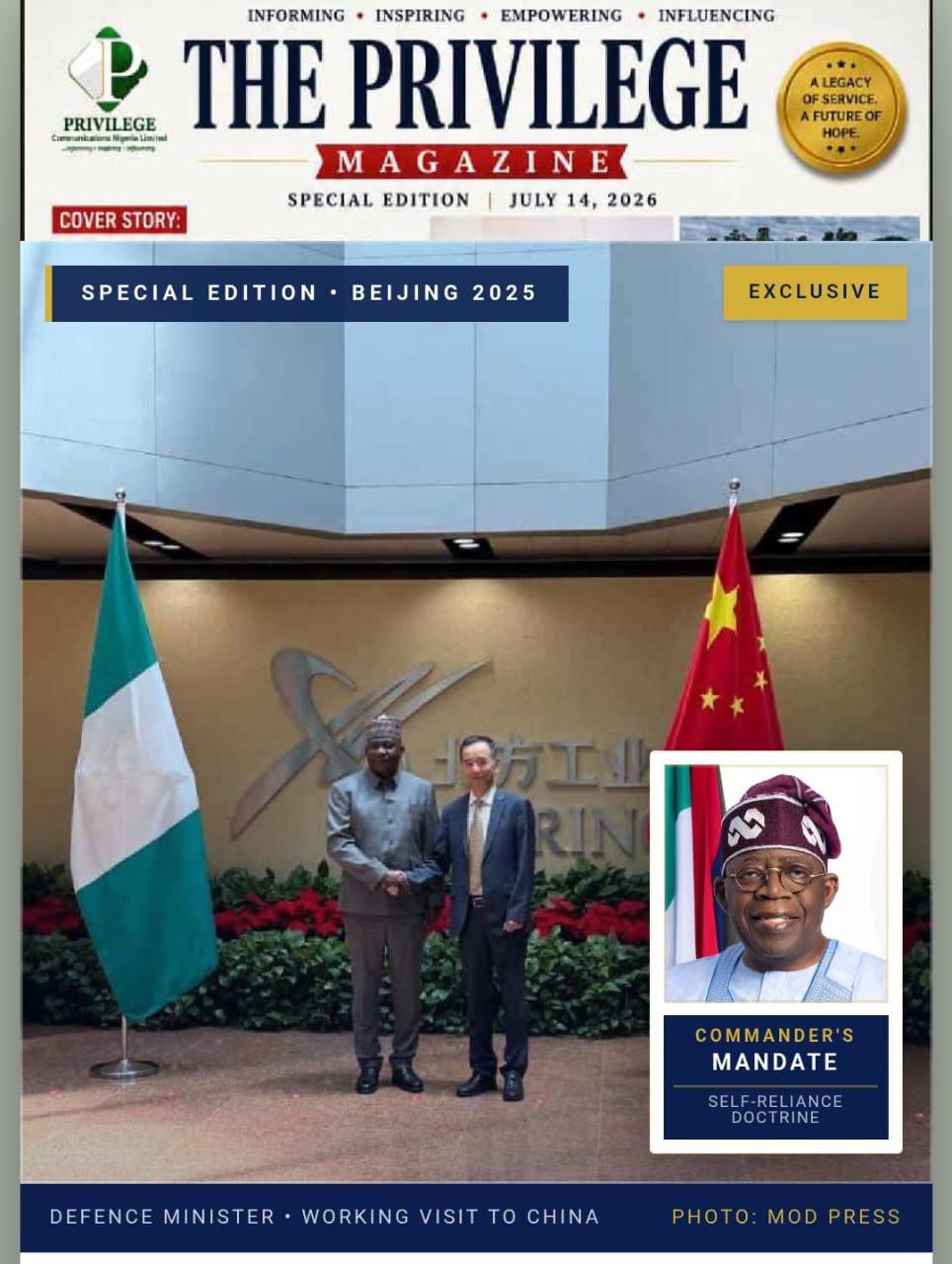
BEIJING, CHINA / ABUJA — In a defining moment for Nigeria’s national security architecture, the Honourable Minister of Defence, General Christopher Gwabin Musa (Rtd) OFR, has concluded a high-level working visit to the People’s Republic of China, securing far-reaching commitments that could permanently reshape Nigeria’s defence production landscape.
The visit, undertaken on the directive of the President and Commander-in-Chief of the Armed Forces, President Bola Ahmed Tinubu, GCFR, was far more than a routine defence procurement mission. It was a deliberate strategic engagement centred on one objective: self-reliance.
General Musa, who assumed office as Minister of Defence in 2026, held high-level strategic meetings with two of China’s leading defence conglomerates—China North Industries Group Corporation (NORINCO) and China Electronics Technology Group Corporation (CETC)—as well as senior officials of the Chinese defence establishment and the Embassy of the Federal Republic of Nigeria in Beijing.
Sources at Ship House, Abuja, disclosed that the Minister’s mission was anchored on six strategic priorities, consistent with his recent declaration that “Nigeria cannot continue to depend on foreign defence equipment.”
THE SIX-POINT MISSION
1. Defence Technology Transfer
Negotiating the transfer of critical military technologies to Nigeria instead of relying solely on the importation of finished defence equipment.
2. Revitalisation of DICON
Transforming the Defence Industries Corporation of Nigeria (DICON) into a modern, world-class defence manufacturing hub capable of meeting Nigeria’s strategic needs.
3. Joint Defence Production
Establishing joint production lines for small arms, ammunition, armoured vehicles, tactical equipment and other military hardware within Nigeria.
4. Modernisation of the Armed Forces
Accelerating the modernisation of the Armed Forces of Nigeria through access to cost-effective, battle-tested military platforms and systems.
5. Artificial Intelligence and Emerging Defence Technologies
Leveraging CETC’s expertise in artificial intelligence, electronic warfare, advanced radar systems, cybersecurity and unmanned aerial systems to strengthen Nigeria’s technological edge.
6. Deepening Nigeria–China Defence Partnership
Expanding decades of bilateral military cooperation into a long-term industrial partnership focused on innovation, research, manufacturing and capacity building.
WHAT NIGERIA STANDS TO GAIN
According to briefing documents from the Ministry of Defence, the anticipated benefits extend beyond immediate military needs and are expected to shape Nigeria’s defence industry for generations.
Among the major gains are:
Strengthened indigenous defence production.
Enhanced military capability and equipment modernisation.
Reduced dependence on foreign suppliers.
Improved technical capacity and skills transfer for Nigerian engineers and defence personnel.
Sustainable defence logistics and supply chains.
Greater self-reliance in defence manufacturing.
Increased employment opportunities through the expansion of DICON’s manufacturing capacity.
Significant savings in foreign exchange through local production.
By localising defence production, Nigeria aims to reduce procurement delays that have become increasingly common due to global geopolitical tensions. General Musa recently noted that ongoing international conflicts involving Israel, Iran, Russia and the United States have disrupted global defence supply chains, making local manufacturing an urgent national priority.
BUILDING A MODERN SECURITY ECOSYSTEM
The Beijing mission aligns with General Musa’s vision presented at the Nigerian People’s Strategic Conference and Defence Exhibition 2026 in Abuja, themed:
“Building a Modern Security Ecosystem.”
That vision places indigenous defence production, technology transfer and strategic partnerships at the heart of Nigeria’s long-term national security agenda.


 “WE ARE COMING TO BUILD”
An official who participated in the delegation told THE PRIVILEGE:
“The Minister was very clear to the Chinese side. We are not coming to buy off-the-shelf equipment. We are coming to build, transfer knowledge and produce in Nigeria, for Nigerians, by Nigerians. That is President Tinubu’s mandate.”
Photographs from the visit show General Musa at NORINCO headquarters alongside Nigerian and Chinese officials, exchanging commemorative plaques with CETC executives, and meeting officials at the Embassy of the Federal Republic of Nigeria in Beijing.
A NEW CHAPTER FOR DICON
Defence analysts believe that if the agreements reached during the Beijing visit are fully implemented, Nigeria could save billions of naira in defence procurement costs, create thousands of highly skilled jobs, revitalise DICON into a leading African defence manufacturing hub, and significantly improve operational readiness for troops deployed across the North-East, North-West and North-Central.
General Musa, a former Chief of Defence Staff renowned for his frontline leadership, is expected to brief President Bola Ahmed Tinubu on the outcomes of the visit before unveiling a comprehensive DICON Revitalisation Roadmap.
THE PRIVILEGE ANALYSIS
The Beijing mission signals a fundamental shift in Nigeria’s defence philosophy—from dependence to production, from procurement to innovation, and from importation to industrialisation.
For a nation confronting insurgency, banditry, terrorism and oil theft, the message from Beijing is unmistakable:
Nigeria is no longer shopping for guns. It is building the factories that will produce them.

COMMENTS